KabarJawa.com – Traditional Javanese architecture has various building forms that develop from community needs, environmental conditions, space functions, and cultural values. Among these various forms, the terms Joglo, Limasan, Kampung, and Tajug are some of the types most often mentioned.
Unfortunately, these four names are still often used incorrectly. Not a few people call all traditional Javanese houses Joglo just because the buildings use wood, have terraced roofs, or look like they have typical Javanese house characteristics. In fact, each form has a different architectural character.
The differences between the four types of traditional Javanese houses can not only be seen from the appearance of the roof. The supporting structure, plan shape, spatial arrangement, building function and background of its use are also important elements in recognizing the types of traditional houses in Java.
In the classification of traditional Javanese architecture, building forms are generally known through several basic types, including Panggang Pe, Kampung, Limasan, Joglo, and Tajug. The four forms most often compared are Joglo, Limasan, Kampung, and Tajug.
1. Joglo House
Among the various forms of traditional Javanese houses, Joglo is perhaps the most popular type. The name Joglo is often used to describe Javanese houses in general, although architecturally this building has special characteristics.
One of the most important elements in Joglo construction is the pillars, namely the four main pillars which are an important part of the building structure. The four pillars support the core of the house and form a distinctive construction center.
At the top of the soko guru there is an arrangement of wooden structures known as intercropping. The presence of this element is an important clue when distinguishing Joglo from other types of traditional Javanese houses.
In a number of traditional buildings, Joglo can also be part of a house complex that has certain spatial divisions. Areas such as pendhapa, pringgitan, and ndalem have different functions in traditional Javanese spatial planning.
In the past, the Joglo form was often associated with houses belonging to wealthy families, community leaders or nobles. Its construction requires special materials and workmanship, making this building associated with a certain social status.
However, the assumption that Joglo houses can only be owned by certain groups is no longer relevant as a rule today. Currently, buildings with the Joglo concept can be owned and used by the wider community, both as residences, business premises, cultural buildings and tourist facilities.
2. Limasan House
In general, the Limasan house has a rectangular basic plan with a roof consisting of four areas. This shape is one of the characteristics that differentiates Limasan from Joglo.
Even though both are part of traditional Javanese architecture and can use wood materials, the construction and main shape of the buildings are not the same.
Limasan is known to have various variations, changes in size, addition of space, and development of form can produce several types that still maintain their basic architectural character.
This flexibility means Limasan can be used for various needs. These buildings are not only found as residential homes, but can also be part of traditional complexes with more diverse functions.
Many people often confuse Joglo and Limasan. Mistakes in differentiating between these two buildings usually occur because people only see the material or visual impression.
Even though both can use wood as the main element and both have traditional roof shapes, the main characteristic of Joglo is in its central structure, especially the soko guru and intercropping sari.
Meanwhile, Limasan is more easily recognized by its four-sided roof configuration and rectangular floor plan. In one area, these two types of buildings can even be in the same complex.
3. Village House
The term Kampung often causes misunderstandings. Some people think the name is directly related to the location of the house in a village.
In fact, in the context of Javanese architecture, Kampung is actually a type of building which is differentiated based on the form of construction and roof.
Compared to Joglo and Limasan, the shape of the Kampung generally has a simpler construction. Because of this, this type is widely used as a residence for people in everyday life.
This simplicity does not mean that the village has lower cultural value. In fact, this form shows how the Javanese people developed architecture that could meet basic needs with more practical construction.
Village houses also reflect the relationship between the form of the building and the social conditions of the community. Not all families need large spaces or complex structures. Therefore, traditional architecture develops in various levels of form according to the needs of its users.
4. Tajug House
Different from Joglo, Limasan, and Kampung which are more often associated with residential houses, Tajug has a different functional character.
In the Javanese architectural tradition, the Tajug form is widely used for buildings related to religious activities. Mosques and places of worship are examples of buildings that often use the Tajug concept.
One of the distinguishing characteristics is the basic shape of the floor plan which tends to be square. The use of space and shape is related to the function of the building which is not the same as a residence.
Therefore, it would not be correct to directly call Tajug a normal residential house. Even though they both have the characteristics of traditional Javanese architecture, the purpose and context of their use can be fundamentally different.
Easy Way to Differentiate between Joglo, Limasan, Kampung and Tajug
To recognize traditional Javanese building types, just looking at the roof is not enough. Several elements need to be considered simultaneously.
Joglo can be recognized by its main structure in the form of four pillars and intercropping. Limasan has a four-sided roof character and generally uses a rectangular plan.
Kampungs have a simpler shape and are mostly used as residences. Meanwhile, Tajug is more closely related to religious buildings and has a square plan character.
However, these characteristics still need to be seen in the context of the building as a whole. Changes in shape, addition of space, renovation, and combining several types can make a building look different from its basic form.
One of the things that is often overlooked in understanding traditional Javanese architecture is the possibility of several types of buildings in one house complex.
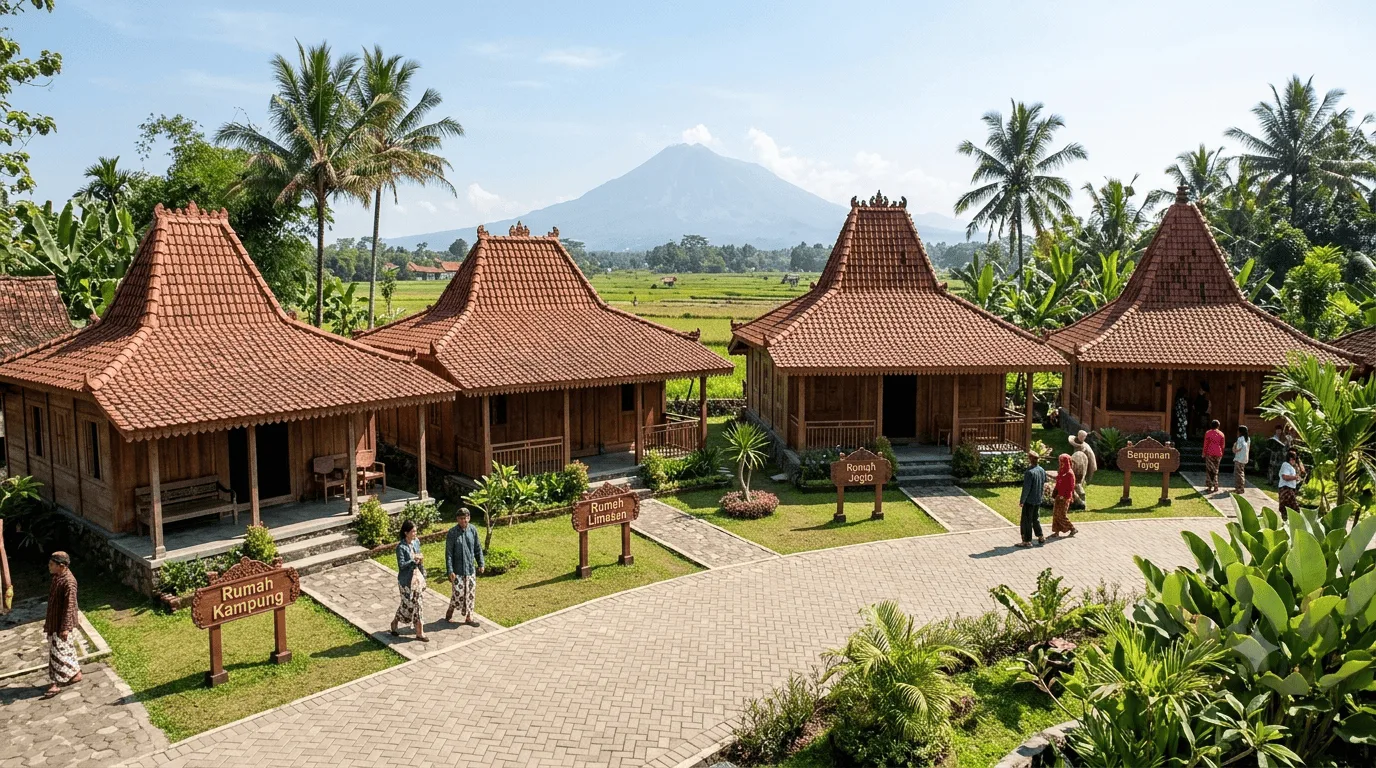
A residential area can have a Joglo-shaped pendhapa, a Limasan-shaped main building, and additional buildings that use Kampung construction. This merger was not a mistake, but rather part of the development of traditional Javanese spatial planning.
Therefore, it is not appropriate if a complex is directly called a Joglo house just because there is a building with a Joglo roof in it. ***
PakarPBN
A Private Blog Network (PBN) is a collection of websites that are controlled by a single individual or organization and used primarily to build backlinks to a “money site” in order to influence its ranking in search engines such as Google. The core idea behind a PBN is based on the importance of backlinks in Google’s ranking algorithm. Since Google views backlinks as signals of authority and trust, some website owners attempt to artificially create these signals through a controlled network of sites.
In a typical PBN setup, the owner acquires expired or aged domains that already have existing authority, backlinks, and history. These domains are rebuilt with new content and hosted separately, often using different IP addresses, hosting providers, themes, and ownership details to make them appear unrelated. Within the content published on these sites, links are strategically placed that point to the main website the owner wants to rank higher. By doing this, the owner attempts to pass link equity (also known as “link juice”) from the PBN sites to the target website.
The purpose of a PBN is to give the impression that the target website is naturally earning links from multiple independent sources. If done effectively, this can temporarily improve keyword rankings, increase organic visibility, and drive more traffic from search results.