KabarJawa.com – Urip iku urup is an expression that is often used to describe the Javanese people’s view of life regarding the meaning of human existence. In simple terms, this sentence can be interpreted as “life is burning”.
However, the meaning of the words “light up” or “urup” in this expression does not mean living a life full of noise or trying to be the center of attention. On the contrary, it contains a message that humans can be a light, provide benefits, warm and bring goodness to life around them.
In the midst of modern life which often measures success through wealth, position, popularity and personal achievements, the philosophy of “urip iku urup” offers a different measure. A meaningful life is not only a life that manages to collect something for itself, but also a life that leaves benefits for others.
This expression is interesting because it was born from the Javanese perspective which sees humans as part of a wider life. A person never truly lives alone. He grows up with his family, interacts with neighbors, depends on the environment, and becomes part of society.
Therefore, the important question in this philosophy is not only “what do I have?”, but also “what have I given?”
The Meaning of Life Is Life
Linguistically, “urip” means life. However, in the context of Javanese philosophy, life is not only understood as a biological state when a person breathes and goes through the day. Life is a journey. It contains responsibility, relationships with others, and the opportunity to do something meaningful.
The word urip iku urup can be interpreted as “life is flame”, which means life should provide benefits and enlighten the people around it. This parable feels close to the way Javanese people view life. Where a person does not have to have extraordinary wealth to provide benefits. He can give through knowledge, energy, time, attention, advice, or simply presence when others are in need.
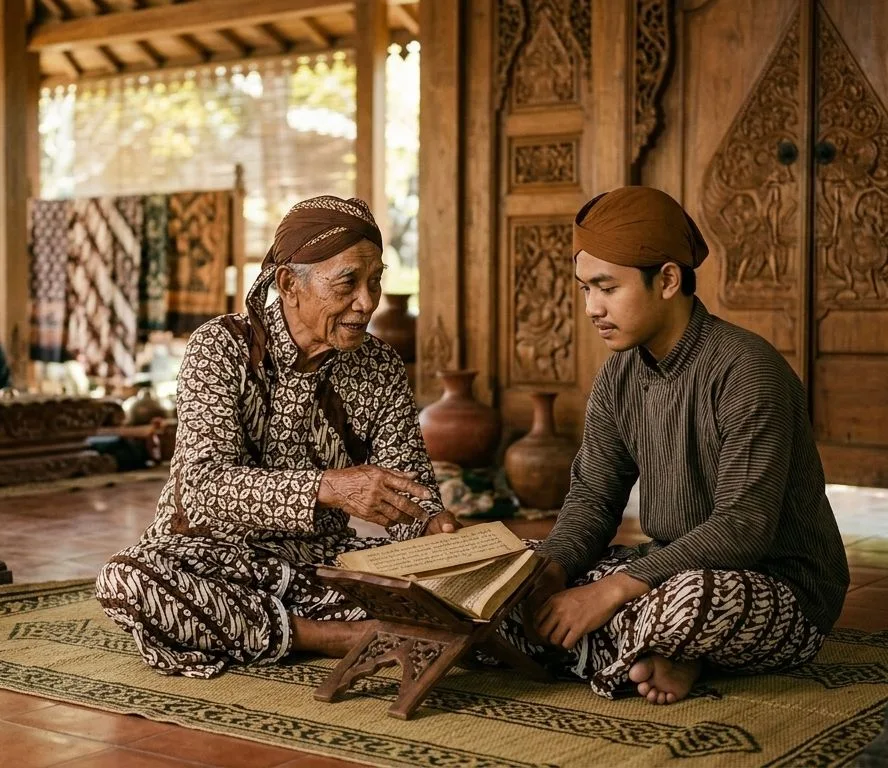
A teacher, for example, may not always know to what extent the knowledge he provides will change a student’s life. Parents also do not always see directly the results of the sacrifices given to their children. However, the good they do can be a light that continues to pass from one generation to the next.
This is where the meaning of “life” becomes deeper. Life is not just about how long a person is in the world, but about how he utilizes life’s opportunities.
The word “urup” can be understood as lit. Fire and light are powerful symbols in many cultures, including in the way Javanese people understand life. Light illuminates a dark room. Fire provides warmth. A small flame can even be used to light another flame.
This is where the philosophy of “urip iku urup” derives its moral strength. Humans are expected to be a source of goodness for others. However, being a light does not mean always having to be the most famous, smartest, or most influential person. Light doesn’t always have to be big. A small lamp still has meaning in a dark place.
Likewise with humans. Someone who helps their neighbor with work when they are sick, a child who takes care of their parents, a friend who is willing to listen without judgment, or someone who shares knowledge with others, can all be a real form of “urip iku urup”.
Research published in the “WUNY Scientific Journal” in 2026 compared the philosophy of “urip iku urup” with the concept of “ikigai”. The study concluded that both of them view life as something that must have meaning, but “urip iku urup” emphasizes an outward orientation, namely the benefit of other people and living together.
These findings show that “urip iku urup” is not just a motivational expression. It can be read as a view of life that places human relationships as an important part of the meaning of life.
Why is this philosophy close to Javanese culture?
Javanese society has many values that emphasize the importance of maintaining relationships with others. Among them are mutual cooperation, tepa selira, rukun, andhap asor, and upload-ungguh. These values have the same common thread: humans must not live entirely for themselves.
In a culture of mutual cooperation, for example, someone helps another person not simply because he or she will get an immediate reward. When residents build a house, hold a celebration, experience a disaster, or need help, the community comes together.
This kind of social life shows that a person’s existence becomes meaningful when he takes part in shared life.
Urip iku urup can then be understood as a principle that strengthens this perspective. Everyone has their own light. Some enlighten through knowledge, some through energy, some through caring, and some simply through good attitudes carried out consistently.
In research on “urip iku urup” in Javanese society as stated in the latest academic studies, this philosophy is associated with group cohesiveness and strengthening social harmony. This means that these principles can function as values that encourage social relationships to remain strong and mutually supportive.
This is where Javanese philosophy shows its strength. A short sentence can hold a broad view about humans and society. Even though it has a message about providing benefits, “urip iku urup” should not be interpreted as an obligation to continuously sacrifice oneself.
There are times when a person needs to rest. There are times when someone has to say no. There are also situations where helping other people actually makes you lose your ability to survive. Therefore, this philosophy needs to be understood in a balanced way.
A person will not be able to be a light for others if he himself continues to be extinguished. Taking care of yourself, maintaining your health, developing your abilities, and fulfilling your personal needs is not a form of egoism. All of this can be a way to keep someone’s strength to do good.
Good light is not light that burns itself to the ground in a short time. Good light is light that can continue to burn. In the context of modern life, this meaning becomes increasingly important. Many people feel like they have to always be available to others. They want to help everyone, meet all expectations, and don’t want to disappoint anyone.
In fact, providing benefits must also be adjusted to abilities. One can help without sacrificing one’s entire life. He can share without having to lose himself. He can care without having to let other people take advantage of his kindness.
Thus, “urip iku urup” is not a teaching to erase oneself, but rather an invitation to make one’s existence useful.
Reasons This Philosophy Remains Relevant Today
The world has changed. Today’s Javanese people no longer live entirely in a village environment like previous generations. Many people live in cities, work in digital spaces, and interact via social media. However, the human need to help each other never completely disappears.
In fact, in the digital era, the philosophy of “urip iku urup” has found a new form of application. A person can be a “light” by sharing the right information. It can help others find access to education, employment, public services, or knowledge. He can use his skills to help the community.
On the other hand, social media can also be a space that makes someone lose the meaning of “urup” when it is used to spread hatred, slander, false information, or embarrass other people. Therefore, this philosophy can be a simple reminder: before speaking, writing, or sharing something, ask whether the action brings benefits or adds darkness.
Research on “urip iku urup” published in the “Journal of Japanese Language Education and Linguistics” also sees this philosophy as a reflection of the Javanese way of looking at life. This study places language not only as a means of communication, but also as a reflection of the way a society understands the world and life.
This is the reason why Javanese philosophy remains relevant. It doesn’t have to be applied in the old way to still have meaning. Its value can be brought to the classroom, workplace, family environment, society, and even the digital world.
In the end, “urip iku urup” teaches that life doesn’t always have to be big to be meaningful. Not everyone has to be a leader. Not everyone has to be famous. Not everyone has to have wealth to be able to help others.
Sometimes, the greatest benefits come from simple actions: teaching something, helping someone get back on their feet, keeping their word, providing an opportunity, or being present when someone else is going through a difficult time.
Javanese society inherited this philosophy not to make people compete to be the brightest. On the other hand, “urip iku urup” teaches that everyone has the possibility to be a light in their respective places.
There are people whose light illuminates the family. Something illuminates the environment. Someone enlightened his students. Others may only help one person at a time. However, a light still has meaning when it is present in the midst of darkness.
So, the deepest meaning of “urip iku urup” is perhaps not about how much someone can give. This philosophy is both simpler and deeper: “as long as we are alive, we must not let our existence bring any benefit to the life around us.”
Because humans may not always be remembered for how much wealth they have accumulated. He is also not always remembered for his position or popularity. However, the kindness that has been given, the knowledge that has been shared, the help that has been provided, and the warmth that has been provided can continue to live in other people’s memories. That’s a burning life. That is the true meaning of “urip iku urup”.***
PakarPBN
A Private Blog Network (PBN) is a collection of websites that are controlled by a single individual or organization and used primarily to build backlinks to a “money site” in order to influence its ranking in search engines such as Google. The core idea behind a PBN is based on the importance of backlinks in Google’s ranking algorithm. Since Google views backlinks as signals of authority and trust, some website owners attempt to artificially create these signals through a controlled network of sites.
In a typical PBN setup, the owner acquires expired or aged domains that already have existing authority, backlinks, and history. These domains are rebuilt with new content and hosted separately, often using different IP addresses, hosting providers, themes, and ownership details to make them appear unrelated. Within the content published on these sites, links are strategically placed that point to the main website the owner wants to rank higher. By doing this, the owner attempts to pass link equity (also known as “link juice”) from the PBN sites to the target website.
The purpose of a PBN is to give the impression that the target website is naturally earning links from multiple independent sources. If done effectively, this can temporarily improve keyword rankings, increase organic visibility, and drive more traffic from search results.