KabarJawa.com – The Yogyakarta City Government is preparing new steps in an effort to suppress illegal waste dumping in the Code River.
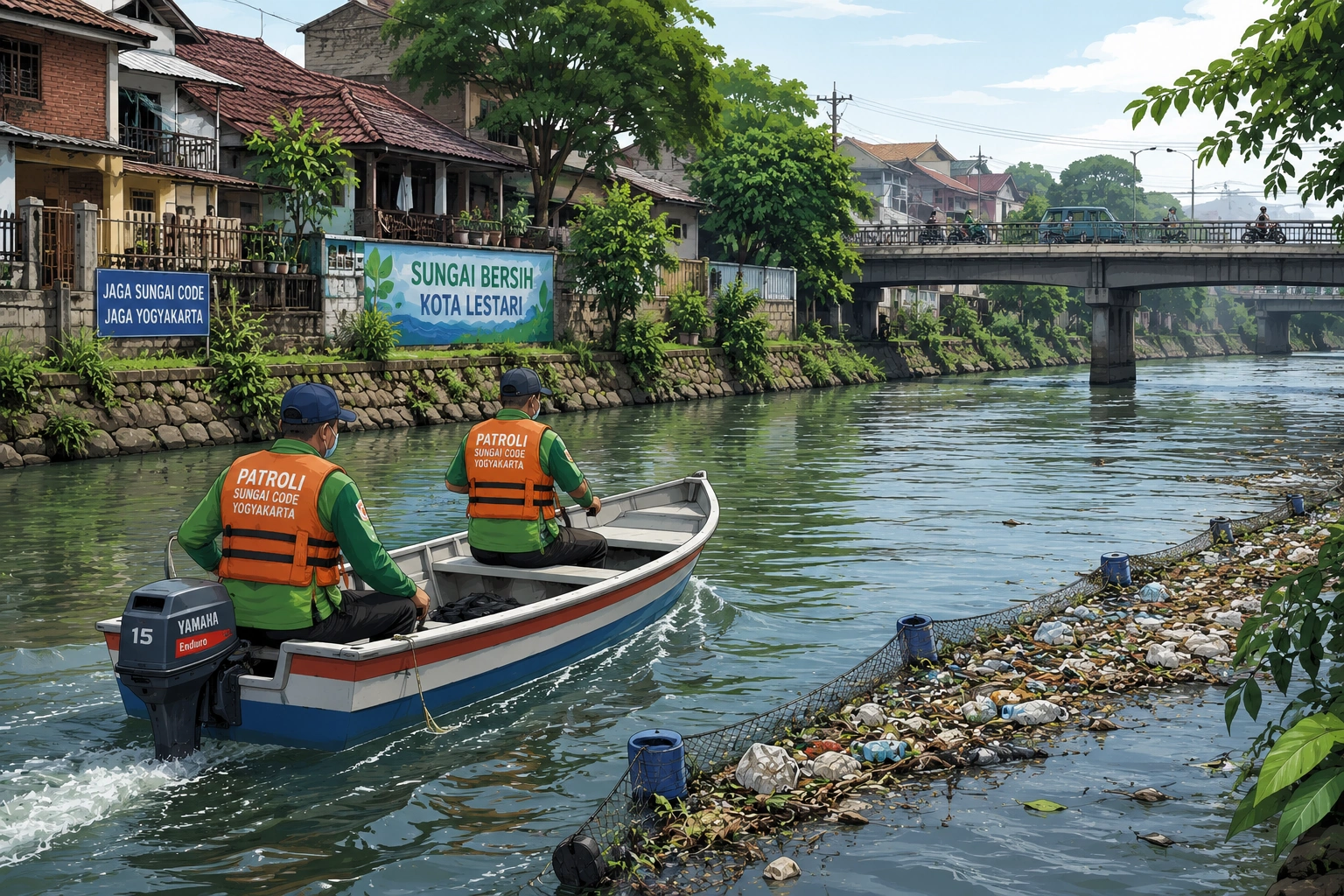
Yogyakarta Mayor Hasto Wardoyo plans to operate a motorized boat to carry out patrols directly along the river that divides the urban area.
This program will begin with the purchase of one boat with an outboard engine to be used as a trial fleet.
In contrast to monitoring from land which is often hampered by access, patrols via waterways are considered capable of reaching points along river banks that have been difficult for officers to monitor.
Hasto conveyed this plan ahead of the anniversary of the Yogyakarta City Government.
“I want to test it for the city government’s anniversary. I want to buy a boat with an outboard engine. In Kalimantan it’s called a ketinting,” said Hasto Wardoyo, Sunday (7/6/2026).
Along the River to Monitor Trash Directly
Patrols using boats will focus on the Code River, which has been one of the priorities for environmental management in the city of Yogyakarta.
According to Hasto, monitoring from a boat allows officers to see river conditions in more detail than just monitoring from the road or bridge.
Many riverbank points are behind densely populated settlements and are not easily accessible by operational vehicles.
With boats with long-tailed outboard engines, the patrol fleet can move more flexibly in narrow and winding river channels.
“With an engine that is not like speed, but has a long tail engine at the back. I use it for patrols on the Code River,” he said.
From the boat, officers can identify locations that are still illegal waste dumping points while monitoring the cleanliness of the river regularly.
Initial Focus on Code River
The choice of Sungai Code as a trial location was not without reason.
This river is one of the main streams that crosses the Yogyakarta City area and is in the middle of an urban environment that is dense with community activity.
Apart from having an ecological function, the Code River is also an important part of the city landscape which is seen every day by residents and tourists.
Therefore, the issue of river cleanliness is considered not only related to the environment, but also concerns the quality of public spaces and the face of the city as a whole.
“It can go upstream, downstream. I can control the rubbish that is dumped arbitrarily in the river. I think so, I want to buy one first,” he said.
Night Patrol Prepared
In the initial stage, patrols will be carried out during the day to test the fleet’s capabilities and the effectiveness of the route it will traverse.
However, the Yogyakarta City Government is also considering night patrols as part of routine surveillance.
This step is based on the finding that illegal waste dumping often occurs when environmental conditions become quiet.
According to Hasto, around 19.00 WIB is a period that is prone to being used by members of the public to throw rubbish into the river.
“Yes, in the afternoon. But if we don’t have a trial later, the patrols could be at 7pm. Because people throw out trash at 7pm,” he said.
It is hoped that the presence of river patrols at night can increase the surveillance effect while providing a deterrent effect for perpetrators.
River Conditions Starting to Improve, Arrangements Continue
The Yogyakarta City Government assesses that the condition of the three main rivers that cross the city, namely the Code River, Winongo River and Gajah Wong River, has shown quite positive developments in recent years.
The waste management program and riverbank arrangement are starting to show results.
However, a number of homework assignments are still found in the field.
Several points along the river still have livestock pens and bird cages which are considered to be disturbing efforts to organize the area.
“There are still several points where there are chicken coops, there are still several points where there are bird cages. We will finish cleaning these points with heavy equipment in the next months,” said Hasto.
Long Term Target: Rivers Clean and Free of Silting
River patrols are part of a wider program to improve the quality of the river environment in the city of Yogyakarta.
Apart from monitoring waste, the government is also targeting reducing silting which has been reducing river flow capacity.
Another step being prepared is the installation of barriers or waste barriers upstream to reduce waste shipments being carried into the city area.
“So the first target is to clean it first, then eliminate silting, and we install barriers, which is important because there is also a lot of rubbish from upstream,” said Hasto.
Towards Cleaner, Publicly Valued Rivers
The Yogyakarta City Government sees rivers not only as water channels, but also as part of the city’s living space which has social, environmental and economic value.
A clean and orderly river has the potential to become a more comfortable public space for residents while supporting the development of sustainable urban areas.
Through boat patrols on the Code River, the government is trying to provide a closer approach to problems on the ground.
Not just watching from the river bank, but directly following the water flow to ensure the cleanliness of the river from upstream to downstream.
This program will be the first step in a long-term effort to make rivers in the city of Yogyakarta cleaner, more orderly and free from the habit of littering.
PakarPBN
A Private Blog Network (PBN) is a collection of websites that are controlled by a single individual or organization and used primarily to build backlinks to a “money site” in order to influence its ranking in search engines such as Google. The core idea behind a PBN is based on the importance of backlinks in Google’s ranking algorithm. Since Google views backlinks as signals of authority and trust, some website owners attempt to artificially create these signals through a controlled network of sites.
In a typical PBN setup, the owner acquires expired or aged domains that already have existing authority, backlinks, and history. These domains are rebuilt with new content and hosted separately, often using different IP addresses, hosting providers, themes, and ownership details to make them appear unrelated. Within the content published on these sites, links are strategically placed that point to the main website the owner wants to rank higher. By doing this, the owner attempts to pass link equity (also known as “link juice”) from the PBN sites to the target website.
The purpose of a PBN is to give the impression that the target website is naturally earning links from multiple independent sources. If done effectively, this can temporarily improve keyword rankings, increase organic visibility, and drive more traffic from search results.