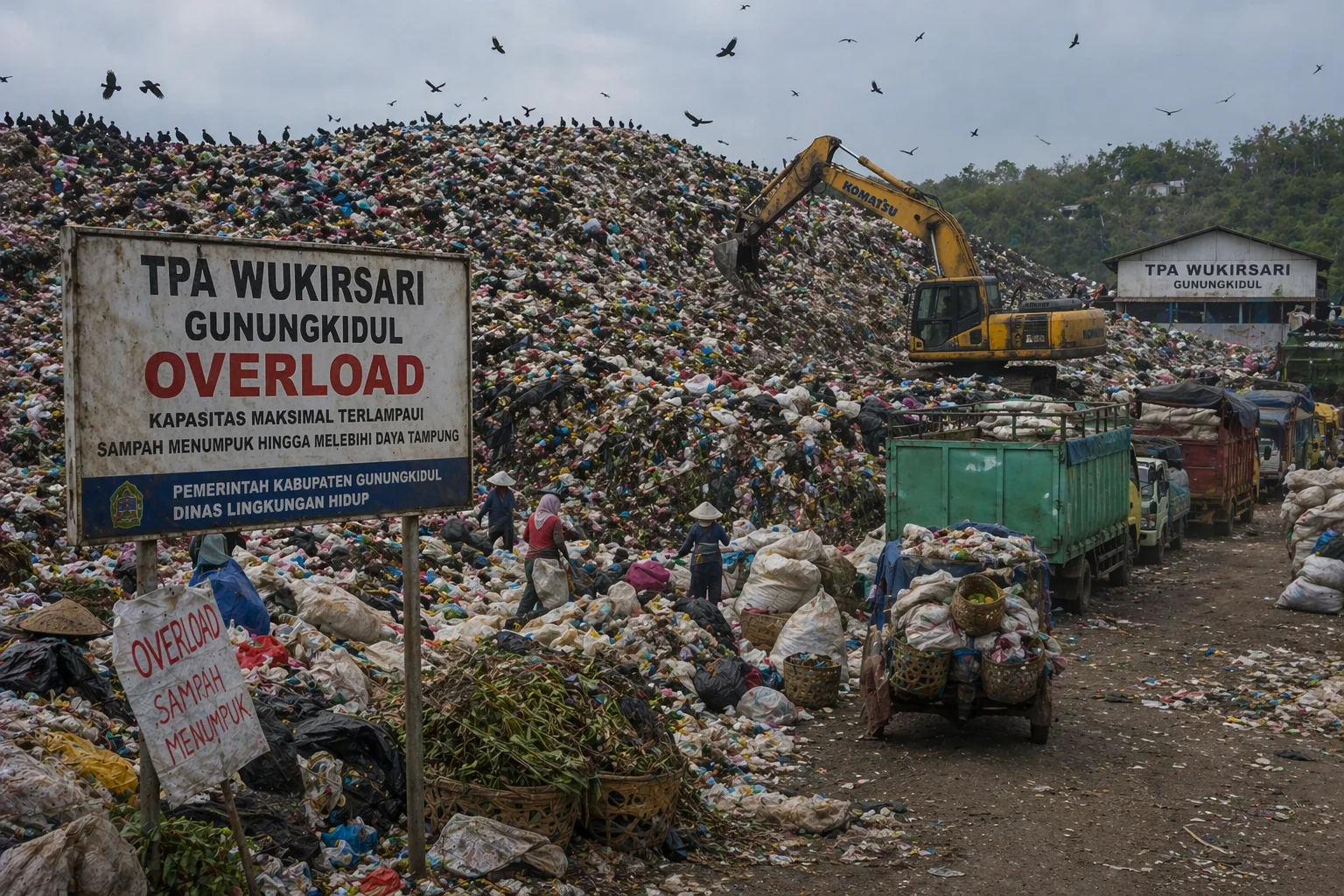
KabarJawa.com– Gunungkidul faces serious problems in waste management. Head of the Gunungkidul Environmental Service (DLH), Edy Basuki, emphasized that the condition of the Wukirsari Final Disposal Site (TPA) is currently overloaded.
This situation forces local governments to immediately carry out a major transformation in the waste processing system, from old methods to more modern and sustainable technology.
Wukirsari Gunungkidul Landfill Disposal Technique
Edy Basuki explained that so far the Wukirsari TPA still uses the open dumping technique, namely an open waste disposal method without optimal processing.
This method not only accelerates the accumulation of waste, but also has the potential to cause environmental pollution.
Therefore, DLH Gunungkidul is pushing for a change towards a Refuse Derived Fuel (RDF) system, which is able to process waste into a renewable energy source.
This transformation is not just a discourse. The government has started processing the construction of an RDF-based Integrated Waste Processing Site (TPST).
In this system, officers will sort the waste in a structured manner before processing it into alternative fuel.
The results of this processing will later be distributed to industry, especially cement factories, as a substitute for fossil fuels.
This step is part of a larger strategy to reduce the volume of waste while increasing its economic value.
With the RDF system, waste is no longer a burden, but turns into a useful resource.
However, this change also brings social consequences that are not simple. Edy Basuki emphasized that in the future RDF TPST concept, there will be no more scavenger activities in the processing area.
Solutions for Scavengers
This policy requires the government to immediately formulate a solution for scavengers who have been dependent on activities at the landfill.
The regional government is currently reviewing strategic steps to ensure the group’s economic sustainability without disrupting modern processing systems.
Physically, the government has also mapped the location of the RDF TPST development. The planned area is to the south of the existing landfill.
The land area prepared reaches 4.5 hectares, while the total area of the Wukirsari landfill is currently around 5 hectares.
“This development is expected to be able to overcome capacity limitations which have been the main problem,” he said.
Edy Basuki said that this project targets to start fully operating in 2029.
This target reflects the regional government’s commitment to switching to a more environmentally friendly and efficient waste management system.
From an institutional perspective, the management of the RDF TPST will still be under the Technical Implementation Unit (UPT).
However, the government is opening up opportunities to develop the Regional Public Service Agency (BLUD) scheme in the future.
Discussions regarding changes to management status will proceed further according to system needs and readiness.
The transformation of the Wukirsari TPA into an RDF-based facility is an important turning point for Gunungkidul in facing the waste crisis.
With a more modern technology and management approach, the government hopes to create a waste management system that not only solves environmental problems, but also provides sustainable economic benefits. (ef linangkung)
PakarPBN
A Private Blog Network (PBN) is a collection of websites that are controlled by a single individual or organization and used primarily to build backlinks to a “money site” in order to influence its ranking in search engines such as Google. The core idea behind a PBN is based on the importance of backlinks in Google’s ranking algorithm. Since Google views backlinks as signals of authority and trust, some website owners attempt to artificially create these signals through a controlled network of sites.
In a typical PBN setup, the owner acquires expired or aged domains that already have existing authority, backlinks, and history. These domains are rebuilt with new content and hosted separately, often using different IP addresses, hosting providers, themes, and ownership details to make them appear unrelated. Within the content published on these sites, links are strategically placed that point to the main website the owner wants to rank higher. By doing this, the owner attempts to pass link equity (also known as “link juice”) from the PBN sites to the target website.
The purpose of a PBN is to give the impression that the target website is naturally earning links from multiple independent sources. If done effectively, this can temporarily improve keyword rankings, increase organic visibility, and drive more traffic from search results.