KabarJawa.com – The hopes of residents on the slopes of Mount Merapi to revive climbing tourism are entering a new phase.
After eight years the climbing route was closed, a number of residents agreed to reopen climbing access independently with various rules they had formulated themselves.
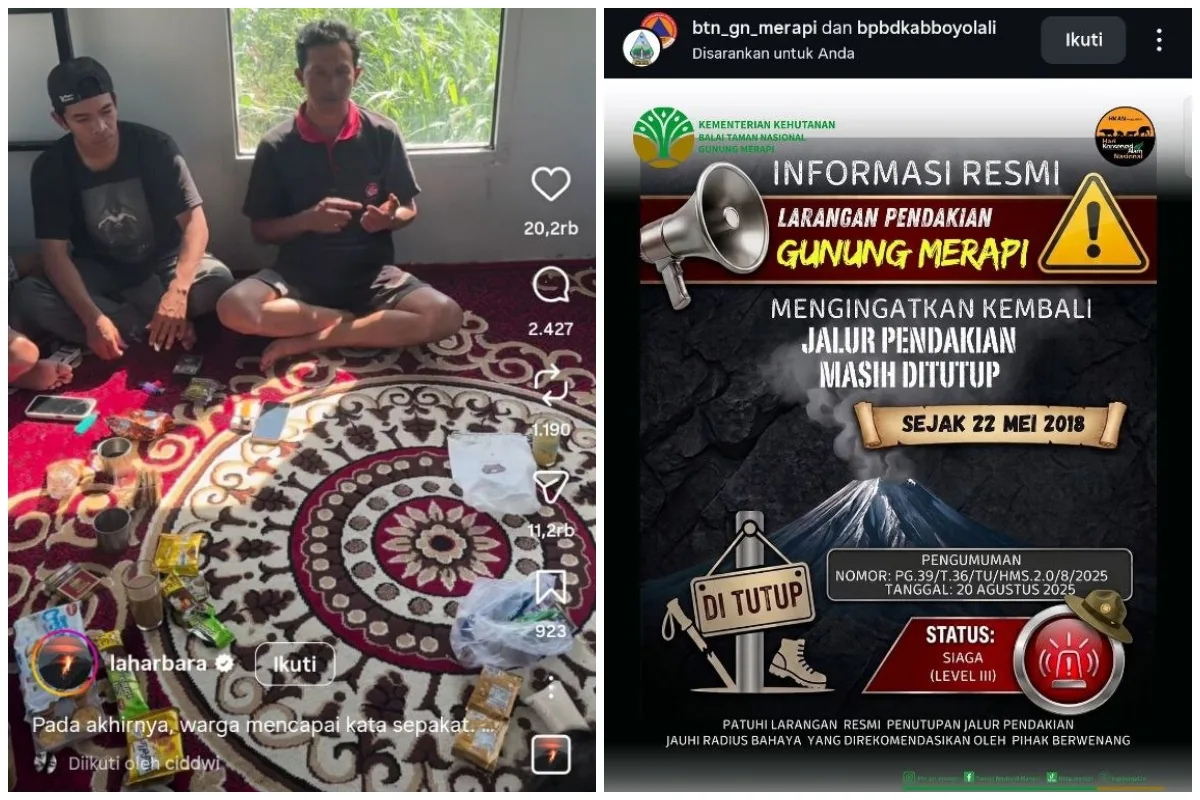
This agreement emerged through uploads from the Instagram account @laharbara which featured deliberations by residents on the slopes of Merapi.
The video immediately attracted the public’s attention and was widely shared on social media, especially among outdoor activists, tourism practitioners, and people around the Merapi area.
Climbing Route Opening Conference
In this forum, residents discussed a number of provisions if the Merapi climbing route via Selo Boyolali was actually reopened.
One of the agreed points is that climbing is only permitted up to the Pasar Bubrah area and not to the top of Mount Merapi.
In addition, the duration of the climb is limited to a maximum of 24 hours. Climbers are also not allowed to set up tents or camp in mountain areas.
These regulations were drafted as an effort to maintain safety while providing space for tourism activities to resume without ignoring existing risks.
The post was accompanied by a narrative describing the long wait the community had been waiting for since the climbing route was officially closed in 2018.
“In the end, the residents reached an agreement. After eight years of waiting without certainty, the residents are now united to reopen the climbing route independently with various conditions and restrictions that have been mutually agreed upon.”
The main hope of the residents is to get the wheels of the economy moving again, which has been in decline for years due to the cessation of climbing activities.
“Hopefully this step will be a good start for the economic revival of the residents after a long period of closure of climbing routes.”
The account manager also stated that the complete mechanism regarding opening the route will be announced in the near future.
“We will provide complete information soon. Bismillah. Because in the end we will never win something we never fought for.”
Route Closure Impacts Residents’ Economy
For the people of the slopes of Merapi, climbing is not just a tourist activity. Over the years, this sector has become one of the main sources of income for residents.
The closure of the route since 2018 has had a direct impact on various local businesses. Starting from climbing guide services, mountain motorbike taxis, equipment rentals, food stalls, homestays, to MSMEs around climbing routes, their income has decreased.
Therefore, the emergence of a citizen’s agreement is seen as an effort to revive economic activity which has been stalled.
TNGM: Official climbing route is still closed
Amidst public optimism, the Mount Merapi National Park Office (TNGM) has reiterated that all Mount Merapi climbing routes are currently still closed.
The head of the TNGM Hall, Heri Wibowo, asked the public not to carry out climbing activities because there had been no policy changes regarding opening routes.
According to TNGM, the closure of climbing routes still refers to the Announcement of the Mount Merapi National Park Office Number PG.39/T.36/TU/HMS.2.0/2025 dated 20 August 2025.
In the announcement, it was stated that the closure which had been in effect since May 22 2018 remained in effect until an undetermined time.
TNGM also appealed to the public to comply with applicable regulations and not enter areas that are within the danger radius as recommended by disaster agencies.
This warning reminds us again that Mount Merapi is one of the most active volcanoes in Indonesia.
The dynamic nature of volcanic activity means that potential dangers can change at any time. This condition is the basis for the government to maintain the policy of closing climbing routes as part of disaster mitigation efforts.
New Polemic on Climbing Mount Merapi
The residents’ agreement to open a climbing route gave rise to two interests that now run side by side.
On the one hand, the community hopes that climbing activities will reopen so that the local economy, which has been sluggish for a long time, can revive. On the other hand, the government continues to prioritize safety aspects by maintaining the status of official route closures.
It is estimated that these differences in attitudes will continue to attract public attention for some time to come.
Residents have expressed their aspirations and drawn up internal regulations, while the decision regarding the official opening of climbing routes remains in the hands of the government in accordance with applicable regulations.
PakarPBN
A Private Blog Network (PBN) is a collection of websites that are controlled by a single individual or organization and used primarily to build backlinks to a “money site” in order to influence its ranking in search engines such as Google. The core idea behind a PBN is based on the importance of backlinks in Google’s ranking algorithm. Since Google views backlinks as signals of authority and trust, some website owners attempt to artificially create these signals through a controlled network of sites.
In a typical PBN setup, the owner acquires expired or aged domains that already have existing authority, backlinks, and history. These domains are rebuilt with new content and hosted separately, often using different IP addresses, hosting providers, themes, and ownership details to make them appear unrelated. Within the content published on these sites, links are strategically placed that point to the main website the owner wants to rank higher. By doing this, the owner attempts to pass link equity (also known as “link juice”) from the PBN sites to the target website.
The purpose of a PBN is to give the impression that the target website is naturally earning links from multiple independent sources. If done effectively, this can temporarily improve keyword rankings, increase organic visibility, and drive more traffic from search results.


